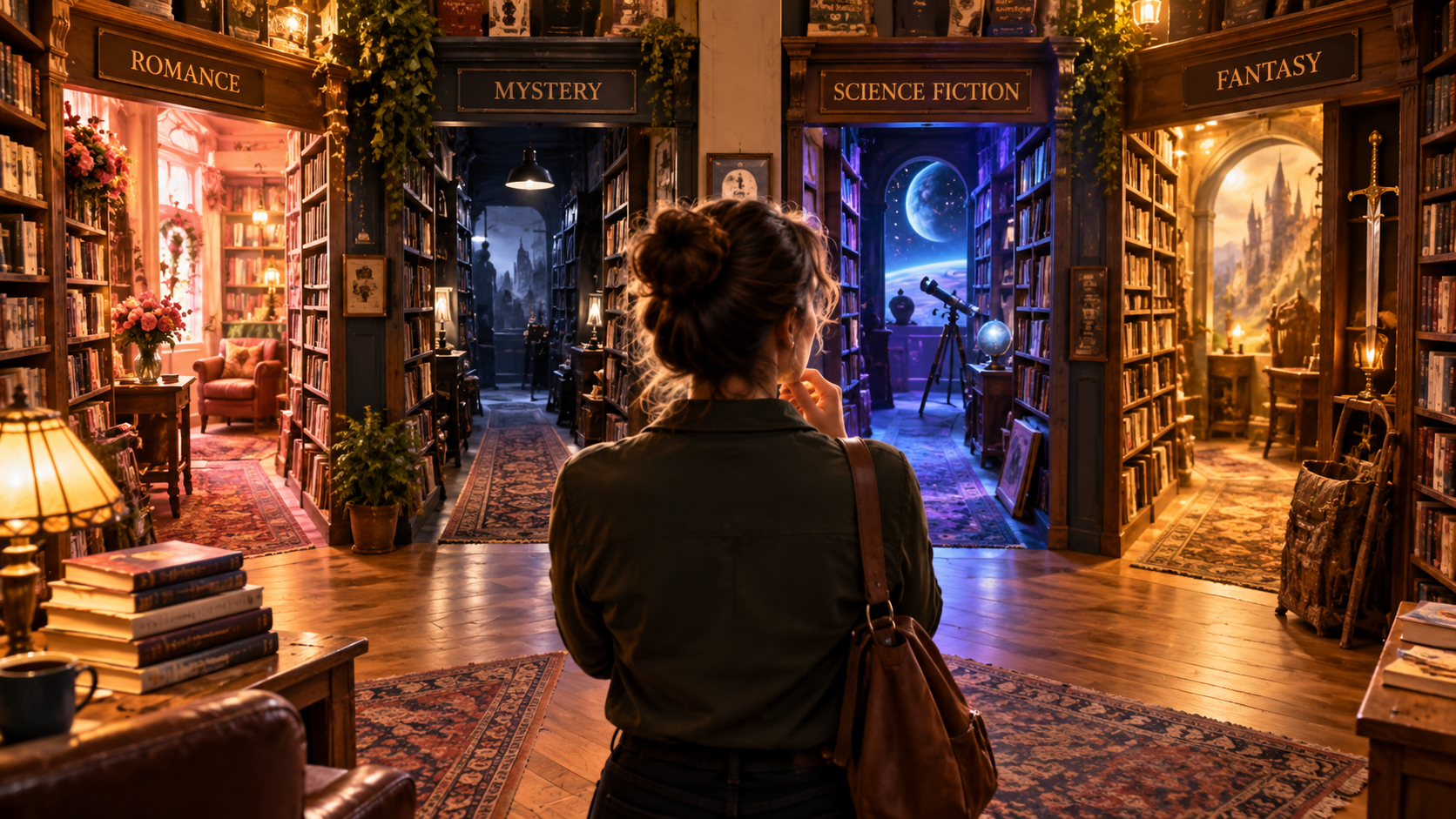
 About twenty years ago, Terry Brooks gave Tracy and me a piece of advice that has stuck with me ever since.
Read outside your genre.
He was talking to us as writers. His point was that if you read nothing but the sort of books you write, sooner or later you start breathing your own exhaust. You encounter the same storytelling conventions, the same approaches to character, the same expectations about pacing and emotion. You can learn an enormous amount by reading the best books in your own genre, but there’s a whole world of storytelling happening outside it.
Recently, I joined a group of writers on Substack called Write Club. Once an evening, we get together and one writer volunteers a chapter of their serial for the rest of us to critique.
The genres are all over the map.
Which means I’ve found myself reading stories I probably wouldn’t have encountered otherwise. Not because I have anything against those genres, necessarily. They’re simply not the shelves I instinctively wander toward when I’m looking for something to read.
And somewhere in the middle of all this reading and critiquing, I remembered Terry Brooks.
Because, twenty years later, I was experiencing exactly what he’d been talking about.
Different genres do different things extraordinarily well.
Read romance and see how another writer handles emotional intimacy.
Read mystery and watch how information is revealed—and withheld.
Read science fiction and encounter ideas that couldn’t exist within the boundaries of the everyday world.
Read fantasy and see what happens when enormous questions about good and evil, power and sacrifice are allowed to become literal.
Read a thriller and watch what happens to character when there isn’t enough time to make the right decision.
It was excellent advice for a writer.
This week, though, something else occurred to me.
Maybe it’s excellent advice for readers, too.
Most of us have favourite genres. There’s nothing wrong with that. If you love romance, there are more wonderful romances in the world than you could possibly read in a lifetime. The same is true of mysteries, thrillers, science fiction, fantasy, historical fiction and just about everything else.
But somewhere along the way, “This is what I love” can quietly become “This is all I read.”
And I wonder what we miss when that happens.
Genre is a useful label on a bookstore shelf. It tells us something about the experience we’re likely to have when we open the book. But it doesn’t tell us everything that’s inside.
Love doesn’t belong to romance.
Danger doesn’t belong to thrillers.
Wonder doesn’t belong to fantasy.
Big ideas don’t belong to science fiction.
Secrets don’t belong to mysteries.
Grief, courage, family, betrayal, friendship, sacrifice, hope, fear, redemption and second chances don’t belong to anybody. They’re human. Writers just approach them from different directions.
That’s what makes venturing outside your usual section of the bookstore so interesting.
A lifelong thriller reader might discover that a great romance can create tension every bit as unbearable as someone creeping through a darkened house with a gun. The stakes are different, but your desperate need to know what happens next isn’t.
A romance reader who has always thought science fiction isn’t for them might discover a story about two people trying to hold a family together while living three hundred years from now—and realize that the spaceships aren’t really the point.
Someone who wouldn’t dream of reading fantasy might encounter a character facing an impossible moral choice and recognize exactly the same struggle they’ve faced themselves, even if this particular character happens to be holding a sword.
Perhaps that’s the real benefit of reading outside our preferred genres.
We get to see familiar things from unfamiliar angles.
A different genre comes with different assumptions. Different traditions. Different ways of creating tension, revealing character, exploring relationships and asking questions. For a little while, the storytelling doesn’t quite work the way we’re accustomed to.
And that can be wonderful.
So I’m going to pass along Terry Brooks’ advice, with one small alteration.
Read outside your genre.
Not because you ought to. Reading for pleasure should never come with homework.
And certainly not because you should stop reading the books you already love.
Just go wandering occasionally.
The next time you see a book and your first reaction is, “Oh, I don’t read those,” maybe give it another look.
Read the description.
Read the first page.
Ask somebody who loves that kind of book to recommend one they think might change your mind.
You might hate it.
That’s allowed.
But you might also discover that something you’ve loved in stories all your life has been waiting for you in a section of the bookstore you’ve never visited.
And twenty years from now, you may be very glad somebody talked you into wandering over there.